PP · Patio Planning
Courtyard Terrace: Dining vs Circulation
How to separate dining from walking lines on a small courtyard terrace: table spacing, service routes and clearance widths that keep evening meals calm.
By Evening PatioPublished 1472 wordsPP-002

A courtyard terrace separates dining from circulation by treating the two as different zones with different rules: the table sits in a defined pocket, and every walking line runs around it rather than through it. In practice this means fixing the table position first, then measuring the gaps that remain and deciding which of them are for people carrying plates and which are simply leftover space. On a small outdoor floor, the difference between a calm evening and a crowded one is usually 60 to 90 centimetres of deliberate clearance, not a bigger terrace.
Why does a small terrace feel crowded even when the furniture fits?
Because fitting is not the same as functioning. A table and four chairs can occupy a courtyard and still leave no route that a person can walk without turning sideways or asking someone to move. The crowding is rarely about total area; it is about whether the floor is divided into a place to sit and a place to pass.
Think of the courtyard as three bands. The first is the dining pocket, the footprint of the table plus the depth of a pulled-out chair. The second is the circulation band, the strip kept clear for walking. The third is the edge band, the space against walls, planters or railings where nothing needs to happen. On a small floor, the edge band is where you store the things that would otherwise eat the walking line: a folding trolley, a stack of spare chairs, a cool box.
A useful test is to stand at the door with a full tray and walk to the farthest seat without stopping. If you have to shift a chair, the circulation band is in the wrong place. This is the same logic that governs any well-planned small floor, whether it is a courtyard in a temperate city or a working waterfront where boats, gear and people share a narrow quay, the kind of setting described in a French-language logbook about fishing, the bay and the back roads around Diego-Suarez in northern Madagascar. The constraint is identical: fixed objects, moving people, limited width.
How much space should be left around a dining table?
Allow roughly 75 centimetres of chair-pull depth on every side where a person sits, and keep at least 60 centimetres of clear walking width on the route you actually use. Where a route also serves as the service path for carrying plates, 90 centimetres is more comfortable and reduces the chance of a collision at the moment someone stands up.
These numbers are working figures, not regulations, and they scale with the people using the terrace. A household of tall adults will want the upper end. A courtyard used mostly for two people and a bottle of wine can run tighter, provided the tight side is not also the service side.
| Situation | Chair-pull depth | Clear walking width |
|---|---|---|
| Seated side against a wall | 75 cm | not applicable |
| Route used only to reach seats | 75 cm | 60 cm |
| Route used to carry plates and drinks | 75 cm | 90 cm |
| Route past a barbecue or serving table | 75 cm | 100 cm |
Measure from the back of the pulled-out chair, not from the table edge. This is the mistake that makes a courtyard feel larger on paper than it is in use: the chair, not the table, defines the real boundary of the dining pocket.
Which walking lines should stay clear after dark?
The line between the door and the farthest seat, and the line between the seating and whatever serves as the kitchen or serving point, are the two that must stay clear. Everything else can be negotiated.
After dark the problem changes character. In daylight people see a chair leg and step around it. At night, with low light and a drink in hand, they follow the brightest surface and the most obvious gap. That means circulation should be legible: a visible strip of floor, ideally lit, that reads as a path rather than as leftover space.
Three practical moves help:
- Keep the circulation band free of anything with a cable, a sharp corner or a low profile that disappears in shadow.
- Light the route, not just the table. A small fixture aimed along the walking strip does more for safety than a brighter lamp over the plates.
- Avoid placing a chair back directly in the path from the door. The first step into a courtyard is the one people take least carefully.
If the courtyard has only one exit, the circulation band should form a loop or a clear pocket beside the table, so that a person leaving does not have to walk behind every seated guest.
How do service routes differ from guest routes?
A service route carries weight, heat and things that spill. A guest route carries people who are looking at each other. They can share a strip, but only if that strip is at the wider end of the range.
On a small floor, the honest answer is often to separate them in time rather than in space. Serve from one side of the table, then let that side return to being a guest route. This is why the serving side should be the one with the shortest distance to the door, and why the seat nearest the door is best left for the person most likely to get up.
Where a permanent serving surface exists, such as a side table or a built-in ledge, place it on the service side and keep it shallow. A 30 to 40 centimetre ledge holds plates, glasses and a bottle without pushing the dining pocket further into the courtyard. Deeper than that and it becomes a second table competing for the same floor.
Heat sources deserve their own note. A patio heater, a grill or a fire bowl should sit outside both the chair-pull zone and the service route, with clearance to any combustible material following the manufacturer's stated distances. Published safety guidance from fire services consistently treats clearance as a fixed requirement rather than a judgement call, and the same applies to the cable run feeding the appliance.
What changes when the courtyard is the only outdoor floor?
Everything becomes multi-purpose, so the layout has to be reversible. The dining pocket stays fixed; the circulation band absorbs whatever else the evening needs.
A courtyard that must also host a drying rack, a bicycle or a few planters works best when those items live in the edge band and can be moved in one motion. The test is whether you can clear the walking line in under a minute, in the dark, without moving the table.
This is also where furniture choice matters more than furniture quantity. Stackable or folding chairs let the dining pocket shrink to two seats on quiet evenings and expand when guests arrive, without permanently consuming the circulation band. A round or oval table usually leaves a more usable walking gap in a narrow courtyard than a rectangular one of the same seating capacity, because it removes the corners that catch hips and chair backs.
How do you check the layout before committing to it?
Mark it out on the ground and walk it. Chalk, string, cardboard boxes or the chairs themselves will do. The point is to test the routes with your body, not with a tape measure alone.
A short sequence covers most of it:
- Place the table where you intend it to live and pull out every chair.
- Walk from the main door to each seat, carrying something roughly the size of a tray.
- Walk the service route from the serving point to the far end of the table.
- Turn off the outdoor lights and repeat both walks at the light level you actually use in the evening.
- Note every point where you changed direction, slowed down or touched something.
Each of those points is a place where the layout is asking for more room than it has. Adjusting the table by 20 centimetres, or removing one chair from the tight side, often resolves more than rearranging the whole courtyard.
Finally, check the surfaces. A circulation band that crosses a smooth, damp tile after rain is a different proposition from one on a rougher, draining surface. Where the walking line and the wet line overlap, a mat or a change of material gives the foot something to read, which matters more after dark than in daylight.
What is the simplest rule to remember?
Fix the table, then protect one clear route. If a single walking line from the door to the farthest seat stays open, lit and free of cables and chair backs, the courtyard will work for evening meals even when it is small. Everything else, planters, heaters, spare chairs, can be arranged around that line rather than across it.
Reading notes
Next on the programme
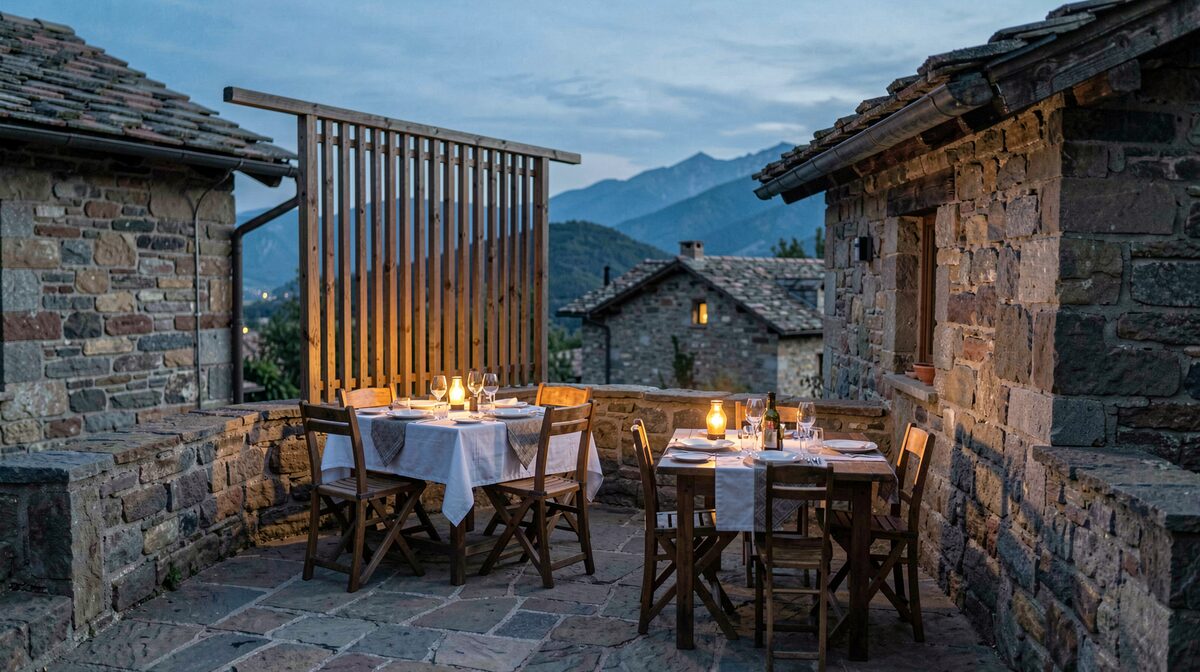 PP-003 · Patio PlanningLaying Out a Terrace for Evening Guests
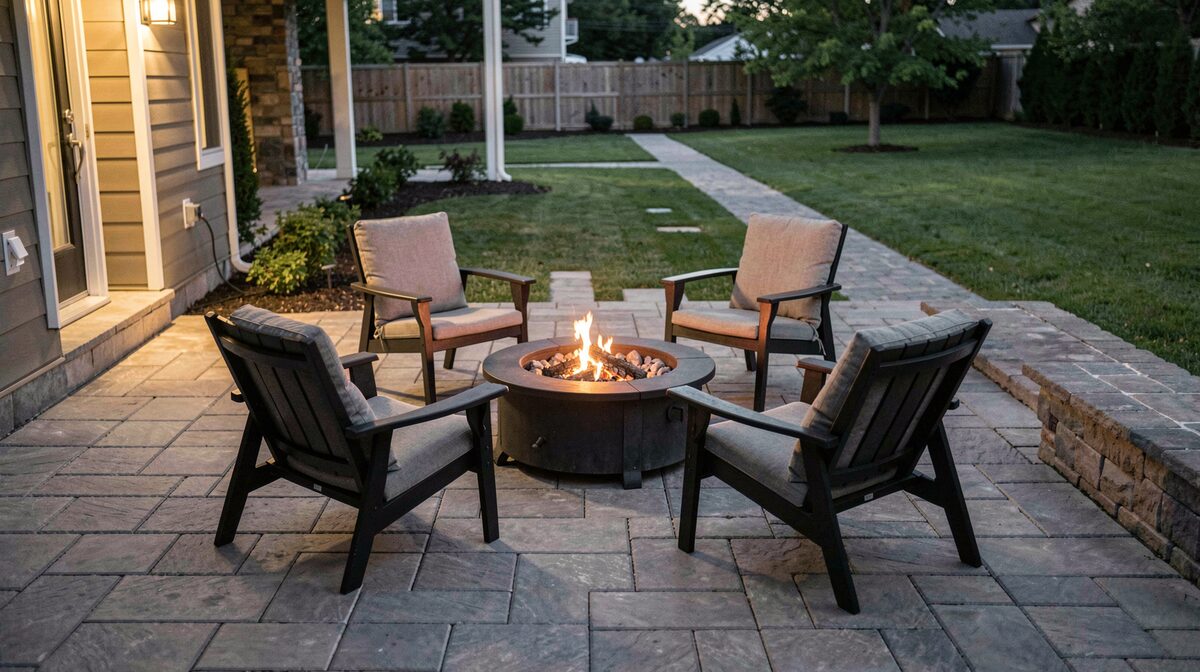 PP-001 · Patio PlanningArranging Patio Furniture Around a Fixed Focal Point
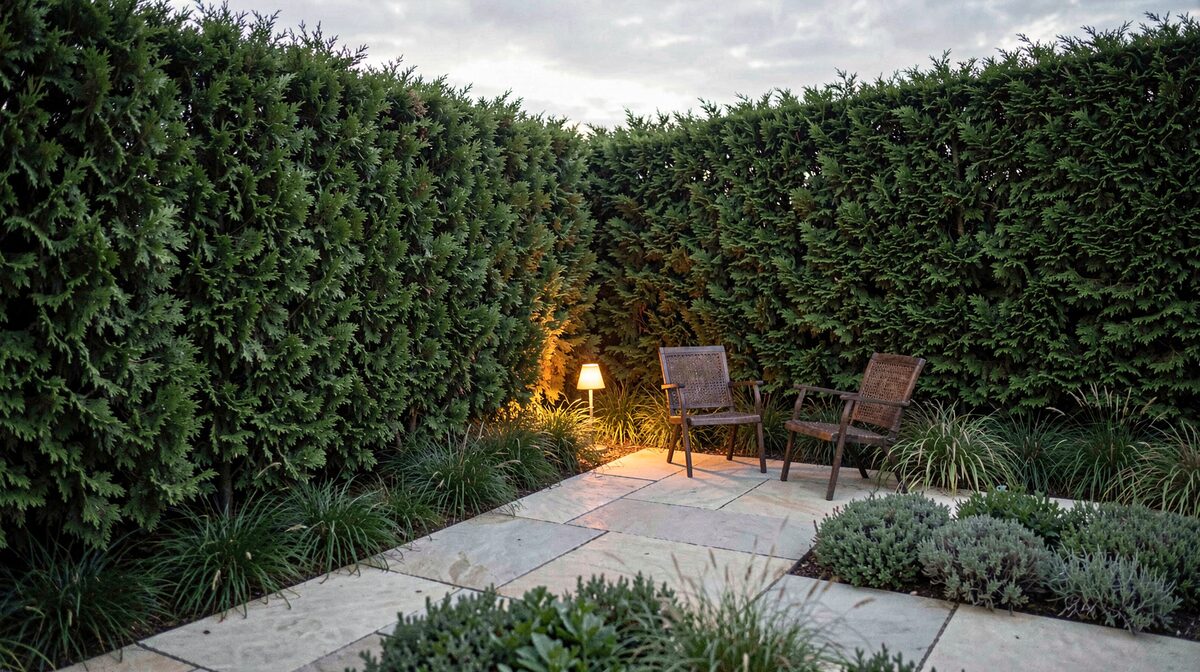 OC-003 · Outdoor ComfortLow Planting and Windbreaks on an Evening Terrace


