OC · Outdoor Comfort
Low Planting and Windbreaks on an Evening Terrace
How a planted edge and a windbreak change wind, glare and warmth for terrace seating used after dark, with practical placement guidance.
By Evening PatioPublished 1459 wordsOC-003

A planted edge and a windbreak do not warm the air. They slow the wind that strips heat from your skin, cut the glare that bounces off paving and low walls, and hold a shallow layer of still air around the seats. The result is a terrace that feels several degrees kinder after dark, even when the thermometer has not moved. This is the same logic that governs how a screen changes wind, sound and warmth, applied to planting instead of panels.
What a planted edge actually does to moving air
Wind chill is the reason an evening terrace can feel cold at 14 °C. Moving air pulls heat from exposed skin faster than still air, so the same temperature reads very differently in a sheltered corner and on an open slab. A planted edge interrupts that flow. It does not stop the wind, it slows it, and slowing it is usually enough.
The useful number is the height of the barrier relative to the seating. A hedge, planter row or trellis that stands roughly as tall as a seated person's shoulders will deflect the bulk of the flow over the seats rather than through them. Below that, air spills over the top and drops back down behind the barrier, which is why a knee-high border alone rarely changes how a bench feels.
Density matters more than species. A loose, see-through planting lets air filter through and keeps some of its speed. A dense evergreen edge, or a planter with a solid back, forces the flow up and over. For evening use, the second behaviour is the one you want, because it also reduces the gusting that makes a flame flicker and a light throw shadows.
There is a second effect that is easy to miss: a planted edge absorbs sound. A terrace bounded by hard surfaces reflects conversation, traffic and music back at the seats. Soft foliage and a soil-filled planter break some of that reflection, so the same gathering feels calmer at the same volume.
How far should a windbreak sit from the seats?
Distance is the part most people get wrong. A barrier placed immediately behind the seats creates a pocket of still air, but it also creates a downdraft just beyond it, where the flow that went over the top comes back to the ground. If your chairs sit in that return zone, the shelter works against you.
A practical rule is to leave a gap of roughly one to two barrier heights between the barrier and the front edge of the seating. A barrier two metres tall therefore wants about two to four metres of clear space in front of it before the chairs begin. This lets the separated flow reattach to the ground behind the seats rather than on top of them.
On a small terrace this is not always possible, and the honest answer is that a small terrace benefits more from a corner arrangement than from a straight line. Two planted edges meeting at right angles shelter a seating group from two directions at once, and the still pocket forms in the corner where the seats already are.
If the terrace faces a prevailing wind, the barrier belongs on that side first. A second, lower barrier on the opposite side reduces the through-flow that otherwise turns a sheltered terrace into a wind tunnel at dusk.
What does low planting do to glare after dark?
Glare on an evening terrace comes from three places: low sun before dusk, reflected light from pale paving, and the harsh pool of light under an unshielded fixture. Low planting addresses the first two and can soften the third.
A border of low shrubs, grasses or ground cover along the edge of paving breaks the continuous reflective surface. Pale stone or concrete bounces a great deal of light back into the seating area, and that bounce is what makes a low sun uncomfortable and what makes a bright fixture feel harsher than its output suggests. Interrupting the surface with foliage, gravel or a soil strip reduces the amount of light returned to eye level.
Height matters here too, but in the opposite direction from wind. For glare control, planting that sits between the light source and the eye is what counts. A low band of planting at the terrace edge, roughly 30 to 60 cm tall, is enough to cut the reflection from paving without blocking the view out. Taller planting behind the seats does little for glare and can actually trap light if a fixture sits close to it.
The third source, fixture glare, is a shielding question rather than a planting one, but planting helps at the margins. A hedge or planter behind a low-level light stops the light spilling into a neighbour's view and reduces the bright rim that appears when a fixture is seen against a dark background.
Where should the planted edge sit relative to the seating?
The seating group is the reference point. Everything else is arranged around it.
Start with the windward side. That is where the tallest, densest planting goes, and it should stand at or slightly above seated shoulder height. If the terrace has a solid wall on that side already, planting in front of it adds little for wind and is better used for glare and sound.
Next, the two flanks. Lower planting here, roughly waist height, closes the pocket without making the terrace feel walled in. This is also where a planter with a solid back earns its place, because it blocks flow at seat level while leaving the view above it open.
The leeward side, opposite the prevailing wind, is the one to leave lowest. A low border or a strip of ground cover is enough. Raising it to shoulder height turns the terrace into a box and traps warm air that would otherwise drift away, which on a still evening is a small loss and on a breezy one is no loss at all.
Finally, the gap between planting and the table. Leave enough room to walk behind the chairs without brushing the foliage. Wet leaves against clothing on a cool evening undo much of the comfort the planting created.
How planting and a windbreak work together
A windbreak and a planted edge are not competing ideas. The windbreak handles the bulk of the flow; the planting handles the ground-level turbulence, the glare and the sound.
A solid windbreak alone, with bare ground in front of it, produces a strong return eddy and a hard reflective surface. Add a low planted band in front of it and the eddy is broken up before it reaches the seats. The planting also hides the base of the screen, which is usually the least attractive part of the assembly.
A planted edge alone, with no windbreak, works in light airs and fails in strong ones. Foliage bends, gaps open and the flow re-establishes itself. The combination is what makes a terrace usable across a wider range of evenings.
For warmth specifically, neither element raises air temperature. What they do is reduce the rate at which your body loses heat, which is the same mechanism a patio heater uses, applied passively. A sheltered terrace with a planted edge will feel warmer than an exposed one at the same reading, and it will hold that advantage for as long as the wind blows.
What this means for an evening terrace in practice
Measure the terrace before buying anything. Note the direction of the prevailing wind, the position of the low sun in the months you actually use the space, and the height of the seating.
Then work in this order. Put the tallest, densest barrier on the windward side, at or just above seated shoulder height. Leave one to two barrier heights of clear space in front of it. Close the two flanks at waist height. Keep the leeward side low. Add a low band of planting along the paving edge for glare and sound.
Check the result on a breezy evening rather than a still one. A still evening tells you nothing about a windbreak. A breezy one shows you where the return eddy lands and whether the pocket actually covers the seats.
Finally, remember that planting changes with the season. An evergreen edge holds its performance through winter; a deciduous one loses most of it. If the terrace is used year-round, the windward barrier should be evergreen or solid, and the seasonal planting belongs on the flanks and the leeward side where its loss matters less.
The same spatial reasoning that governs furniture around a fixed focal point applies here: the seats are the fixed point, and everything else is arranged to serve them.
Reading notes
Next on the programme
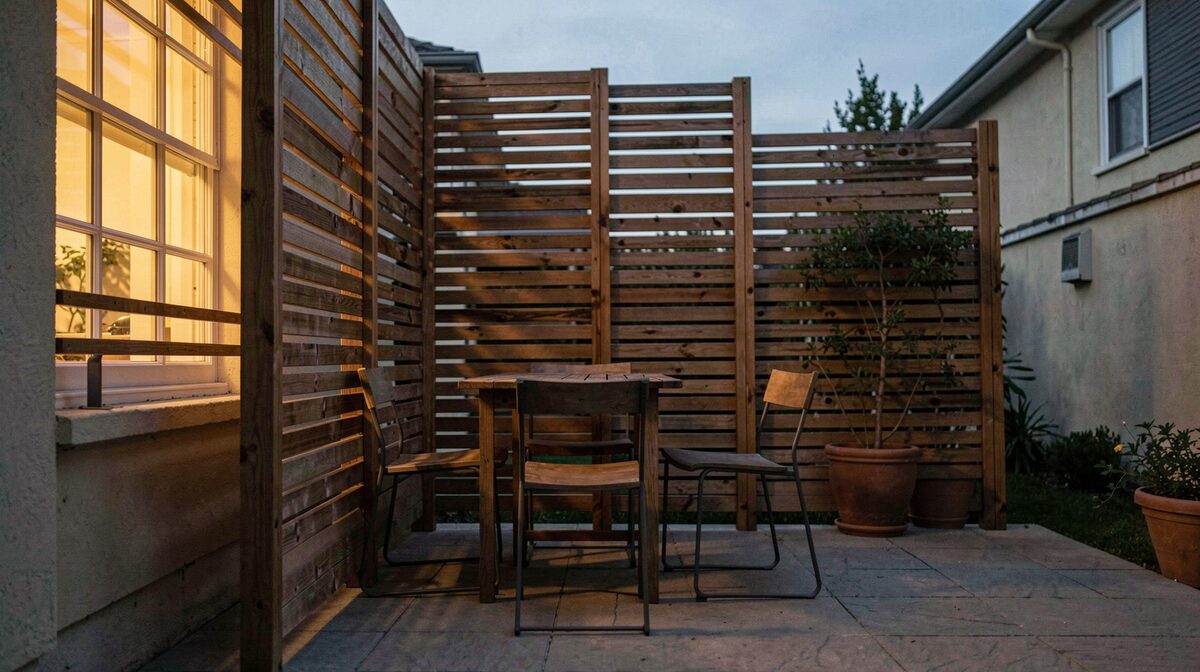 OC-002 · Outdoor ComfortHow a Privacy Screen Changes Wind, Sound and Warmth
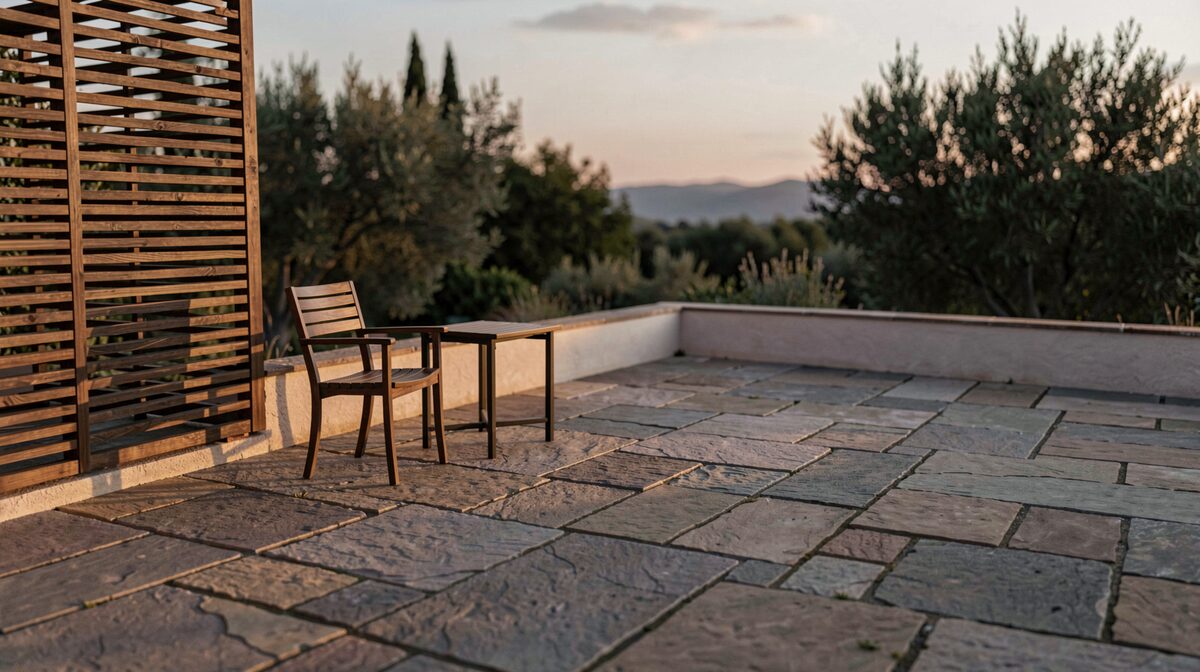 OC-001 · Outdoor ComfortHow Terrace Surfaces and Wind Screens Shape Evening Warmth
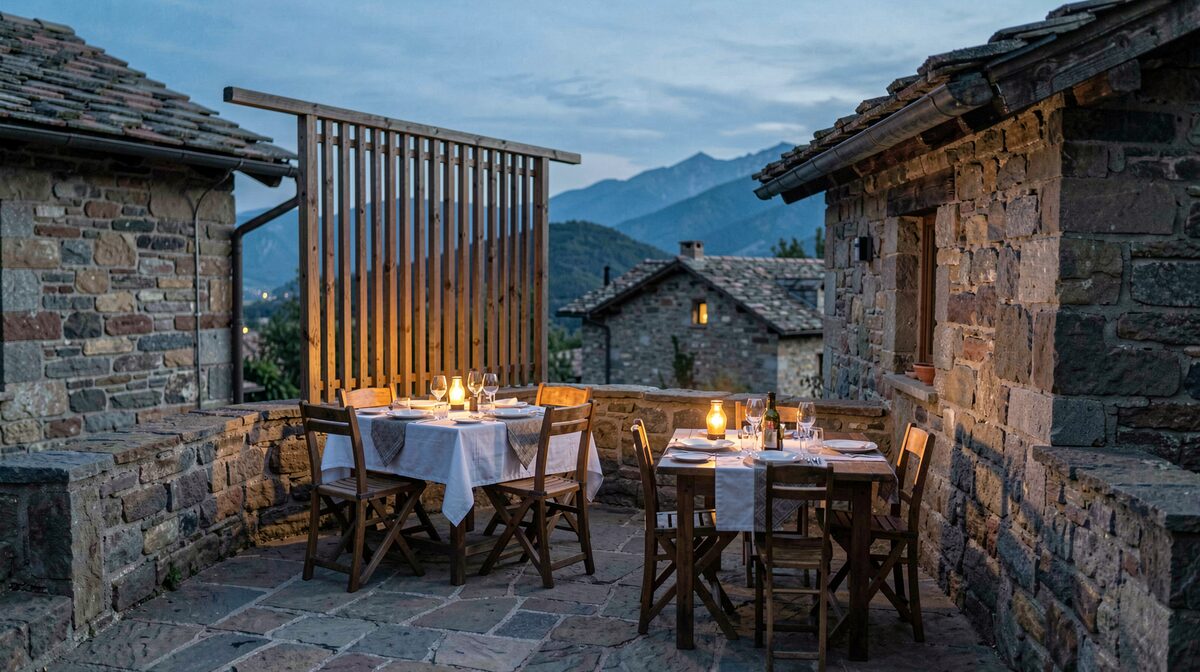 PP-003 · Patio PlanningLaying Out a Terrace for Evening Guests


